Captain Meeks shares personal observations from his individual career and experience on the interview side. He is not speaking on behalf of Southwest Airlines, and this content has not been reviewed or endorsed by Southwest Airlines.
Your Interview Starts Long Before the Handshake
Most pilots think airline interview tips are all about what happens in the interview room. They memorize technical answers. They rehearse airline interview questions. They polish their logbooks until the numbers shine.
And then, without realizing it, they lose the job at the gate.
Not because they weren’t qualified. Not because they weren’t ready. Because nobody told them the truth about when the interview actually begins.
I’m going to tell you that truth.
The $15 Million Decision You’re About to Make
Before we get into tactics, I want you to feel the weight of what’s at stake here.
Over a 30-year airline career, the average pilot earns approximately $15 million in total compensation. Health benefits. Retirement. Travel privileges. A schedule your family can plan around.
Every single one of those dollars flows from a single moment: your airline pilot interview.
Now ask yourself this: Would you walk into a $15 million business deal unprepared? Would you submit a proposal full of errors? Would you wing it?
Of course not.
But here’s what shocks most pilots when they finally hear it, the $15 million decision isn’t made only in the conference room. It’s being shaped long before you ever sit across from a hiring board.
It starts the moment you step into that airport.
The Hidden Evaluation Most Pilots Never See Coming
Airlines are not just companies. They are communities.
Crew members. Gate agents. Deadheading captains. Off-duty HR staff traveling on their benefits. They are everywhere, and they talk.
When you’re a candidate, you are never fully off the record. The pilot interview questions everyone prepares for are only part of the picture.
Here’s a real story that still sticks with me after 15 years on the other side of that table:
A highly qualified candidate, strong hours, clean record, outstanding references, was removed from consideration during final deliberations. The reason never made it into the official notes. But the word came from a deadheading captain who had witnessed this pilot berate a gate agent during a weather delay.
The candidate never knew why they didn’t get the offer.
They probably blamed the interview. They probably ran the Q&A over and over in their head trying to find the mistake. The mistake wasn’t in the room. It was at the gate, 18 hours earlier.
That is why this exists. To give you what the other programs won’t: the truth about how hiring decisions are actually made.
Your 72-Hour Interview Window
Think of your interview as a 72-hour window, not a 60-minute performance.
From the moment you book your flight to the moment you land back home, you are being evaluated. Not by hidden cameras or formal assessors. By the same casual, human observations that shape every professional reputation.
Here is the exact framework for protecting your candidacy during that window:
At the Airport
- Be courteous to every airline employee, every single one
- Do not complain about delays, crowded gates, or slow service
- Know the airline interview dress code: business casual minimum, even if your interview is tomorrow
- Skip the airport bar entirely, fatigue and alcohol show up in ways you can’t predict
At the Hotel
- Treat hotel staff with genuine respect
- Keep noise levels down, other candidates may be in the same hotel
- Go to bed early. Fatigue is visible. Composure requires sleep.
- This is not the night to unwind with new friends from the candidate pool
In Transit
- Be respectful to every driver
- Arrive 30 minutes early, not more than 45
- Do not discuss other airlines. Do not criticize your current employer. Not even casually.
Inside the Building
- Greet every person you encounter, security, receptionists, everyone
- Maintain professional communication throughout breaks and lunch
- Stay composed after the formal interview ends. The evaluation does not stop when the last question is asked.
- Thank people on your way out, and mean it
On the Return Trip
- Stay professional until you are home
- Do not decompress at the airport bar
- Do not discuss interview details with strangers
The Recruiter’s Network Is Bigger Than You Think
This is not paranoia. This is professional reality.
Airlines have internal communication systems that most candidates never account for. Employees share observations. “Culture fit” feedback flows through informal channels. A pilot who encountered you on a jumpseat can surface a comment that shapes a hiring decision.
You will never know which interactions are being tracked. That is exactly why every interaction counts.
Your Communication Audit
Before your interview window begins, run this quick audit on every channel someone from that airline might reach you through:
- Voicemail message, Does it sound professional? Or is it a clipped “leave a message”?
- Email signature, Is it clean, current, and career-appropriate?
- Text message responses, Are you writing in complete sentences when it matters?
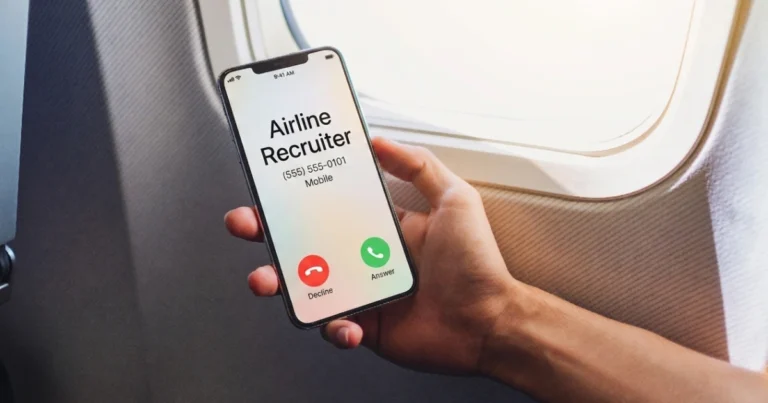
- Phone manner, Are you answering unknown numbers the way you’d answer a call from a chief pilot?
One small detail signals the same thing that a great interview does: this pilot pays attention.
The Resume Paper Detail That Most Pilots Overlook
This one is simple, specific, and almost nobody does it.
When you print your resume to hand to someone at your interview, or anywhere else, use 32lb bright white or ivory resume paper. A ream of 100 sheets costs around $15 at any office supply store.
Here is why it works: when your resume is sitting in a stack of 50, the HR professional can physically feel which candidates used quality paper. It is a subconscious signal. It says I prepared for this. It says I take details seriously. It says everything a first impression should say before you’ve spoken a single word.
These are the margins that separate a hired pilot from a passed-over one.
The Mindset That Changes Everything
Stop thinking of your interview as an event.
Start thinking of it as a 72-hour window for a crew position, because that is exactly what it is.
You would never show up to a trip late, unprepared, or sloppy. You would never treat ground crew poorly and expect it not to reflect on you. You would never treat the job as something that turns on and off based on whether someone official is watching.
Apply that same standard to every single interaction during your interview window.
That is the mindset that gets pilots through an airline pilot interview. Not just qualified. Hired.
Resources Worth Exploring
Aviator Intelligence Masterclass Digital Course
Hundreds of pilots have used this exact system to go from the regionals to a major airline offer. The full preparation process, from resume building to final interview, lives here. Your resume is your first interview, and this course shows you what gets a pilot to the top of the stack.
The Free Online Pilot Community
The questions pilots ask in forums rarely get answered by people who’ve actually sat in the seat. This community has those people.
Stay in the Loop, Hiring Trend Updates
The 2026 hiring window is open and moving fast. Stay informed.
Every week, this delivers one thing: the real insight that turns a qualified pilot into a hired one. The kind of information that lives on the other side of the hiring table, and rarely makes it to the candidate’s side.
See you next week.