Captain Meeks shares personal observations from his individual career and experience on the interview side. He is not speaking on behalf of Southwest Airlines, and this content has not been reviewed or endorsed by Southwest Airlines.
The Pilot Phone Interview Most Pilots Aren’t Ready For
You submitted your application. You checked the box. You told yourself the hard part was coming, the technical questions, the sim eval, the board interview.
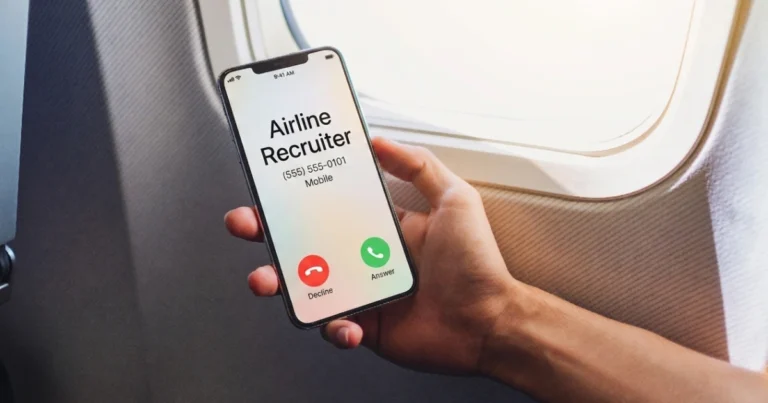
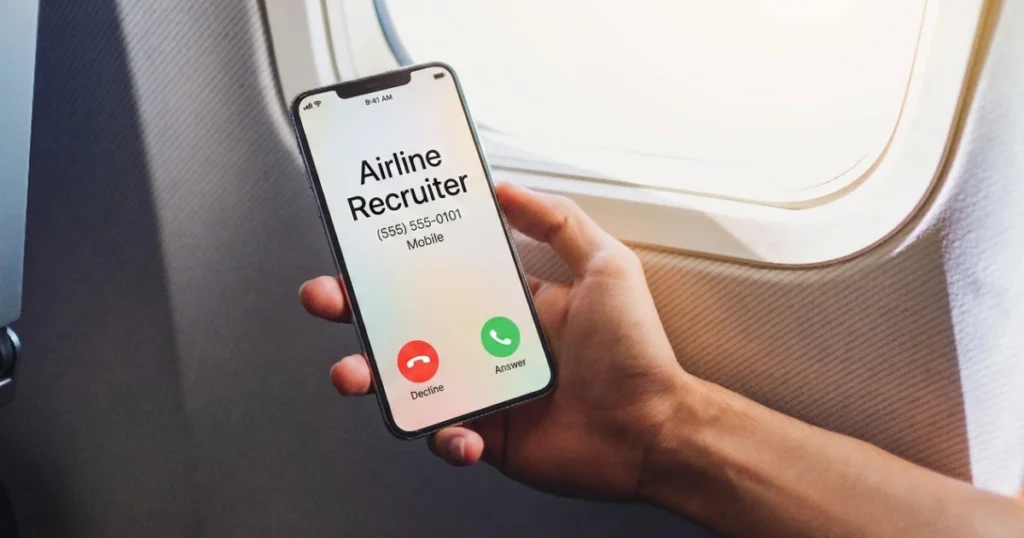
Then your phone rings.
Unknown number. Middle of a Tuesday. You’re at the airport, bag in hand, crew around you.
You answer.
“Hi, this is Sarah from United recruiting. Do you have about 20 minutes to talk?”
And just like that, your airline pilot phone interview has already begun, whether you’re ready or not.
This is the phone screen. And for 30 to 40 percent of applicants, it is also where the opportunity ends.
What’s Actually Being Decided in 20 Minutes
Most pilots think of the pilot phone interview as a formality, a box the recruiter needs to check before the real process begins.
It is not a formality.
In those 20 minutes, four things are being evaluated, and the weight of each one might surprise you:
- Communication skills, 40%. How you speak, how you listen, how clearly you think under low-stakes pressure.
- Preparation and interest, 30%. Did you do your homework? Do you actually want this specific airline, or are you just dialing for dollars?
- Red flags, 20%. One wrong answer here, one careless comment about a former employer, one moment of background chaos, and the conversation is over in ways you will never be told about.
- Basic qualifications, 10%. Your hours, your medical, your availability. This is the smallest piece.
Read that again. Ninety percent of the phone screen has nothing to do with your logbook, resume, or application. It is entirely about how you present yourself, your professionalism, your preparation, and your tone.
That is the part nobody tells you. And that is exactly why so many pilots get eliminated here.
The Call You Are Not Prepared For
Here is what nobody prepares you for: they will call when you are not ready.
Not at a convenient hour. Not when you are sitting at your desk with your application pulled up and your notes in front of you. They will call on a Tuesday afternoon when you are running errands, or walking through a terminal, or in the middle of something that feels impossible to step away from.
And how you handle that moment, those first five seconds, tells the recruiter something your resume never could.
The pilots who get through to the next round are not always the most qualified. They are the most prepared for the call nobody warned them about.
The Framework That Protects You From the Moment You Apply
From the second you hit submit on an application, your phone is no longer just your phone. It is a direct line to your next pilot phone interview. Here is the exact protocol to stay ready:
Phone Readiness
- Record a professional voicemail. Right now. Not later. “You’ve reached John Smith. Please leave your name and number, and I’ll return your call promptly. Thank you.” That is it. No music, no jokes, no casual tone.
- Answer every unknown number professionally: “This is John.” Not “yeah,” not “hello?”
- Keep your phone charged. Keep the ringer on. Check your email daily, including your spam folder.
When the Call Catches You Off Guard
If they reach you at the wrong moment, this is the exact response that keeps the door open:
“Thank you so much for calling. I’m very interested in speaking with you, but I’m currently in [situation]. Could I call you back in [timeframe] when I can give you my undivided attention?”
They will respect this. Every time. A recruiter would rather wait 15 minutes than talk to a distracted candidate for 20.
Never take the call in a noisy location, while driving, or when you cannot fully focus. The call you take in chaos will cost you more than the call you returned five minutes later.
The Questions They Will Ask, And What They Are Really Listening For
The words matter less than the instinct you show in answering them. Here is what sits behind the seven pilot interview questions you will almost certainly hear:
“Walk me through your flying background.” They want 90 seconds, in order, hitting the milestones. They are not listening for every hour, they are listening for clarity and confidence. Practice this until it flows without effort.
“Why this airline?” Two or three specific reasons. Not what is on the About page. Recent routes, new aircraft, a base that matters to your life. Show that you did actual research. Generic enthusiasm is a yellow flag.
“Are you interviewing with other airlines?” Be honest. Be tactful. “[This airline] is my top choice because…” and then mean it. They are not asking to trap you, they are asking to measure your commitment.
“Have you ever failed a checkride?” If yes, own it completely. Brief, honest, no blame. What you learned. How it made you a better pilot. The worst answer here is not the failure itself. It is a pilot who cannot take responsibility for it.
“Do you have any questions for me?” Always have two or three ready. Thoughtful, intelligent questions. This is not a formality either. It signals whether you are genuinely engaged or just going through the motions.
These are the airline interview questions that show up on almost every recruiter call, regardless of carrier. Knowing them is half the work. Sounding like a pilot who has already lived the answer is the other half.
The Red Flags That End Calls Instantly
Some pilot phone interview red flags are obvious. Others catch even sharp pilots off guard:
Instant disqualification:
- Unprofessional voicemail
- Background noise you can’t control
- Any negativity toward a current or former employer
- Contradicting something on your application
Major concerns:
- Excessive filler words, “um,” “like,” “you know”
- Long, rambling answers with no clear point
- No questions for the recruiter
- Sounding like you applied everywhere and this airline is just another number
The one that surprises pilots most: Not knowing basic company information. Fleet type, major bases, something in the news from the last 30 days. A two-minute search before your interview window opens protects you from a completely avoidable elimination.
After the Call, What the Signs Tell You
Not every recruiter will give you clear signals. But these patterns tend to hold:
A good sign is a recruiter who stayed engaged, asked follow-up questions, gave you a specific timeline, and invited your questions back.
A neutral sign is a professional but brief call, minimal back-and-forth, a generic “we’ll be in touch.”
A concerning sign is a call that felt rushed, where the recruiter seemed disengaged, where no timeline was mentioned, and where it ended abruptly.
Regardless of how it went, if you have their contact information, send a thank-you email within 24 hours. Keep it short, keep it professional, and reinforce your interest in exactly one or two sentences. That email costs you five minutes and it is remembered.
If you make it through the phone screen, the evaluation doesn’t pause when you hang up. (For a deeper read on what happens during the 72-hour window from the moment you book your interview travel, see Airline Interview Tips: The 72-Hour Window Nobody Talks About.)
Your Action Item
Record your voicemail right now. Play it back. Listen to it the way a recruiter would hear it for the first time.
If it does not sound like someone you would trust with a $15 million decision, re-record it today.
That is five minutes. And it is one of the most consequential five minutes in your preparation.
Resources Worth Exploring
Aviator Intelligence Masterclass Digital Course
Hundreds of pilots have used this exact system to go from the regionals to a major airline offer. The full preparation process, from voicemail setup to recruiter call to final board interview, lives here. Your phone screen is your first interview, and this course shows you what gets a pilot through to the next round.
The Free Online Pilot Community
The questions pilots ask in forums rarely get answered by people who’ve actually sat in the seat. This community has those people.
Stay in the Loop, Hiring Trend Updates
The current hiring window is moving fast. Stay informed.